This section explains why perfect data curves in the lab can completely fail in real-world puffing tests.
Laboratory Standard Combustion Testing: Technical Conditions vs. Real-World Differences
Introduction: The Failure of Data
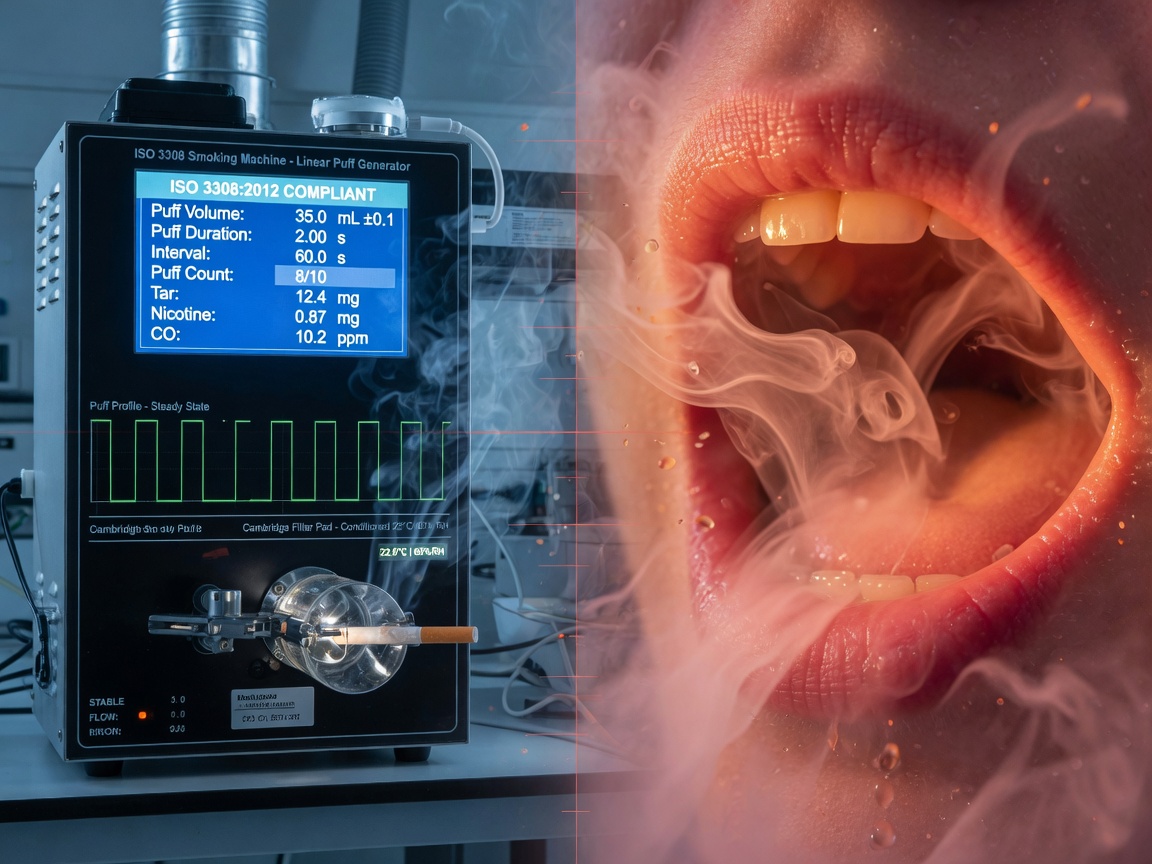
At two in the morning, in the constant temperature and humidity room of a Shanghai tobacco R&D center, the air was dry, cold, and metallic. I stared at the data curves on the display — a set of nearly perfect ISO 3308 standard test results: each puff volume precisely controlled at 55ml, puff pressure stable at -100mmHg, and the interval strictly adhering to a 60s frequency. By the data, this new aerosol product's nicotine release, simulated tar value, and heating efficiency were all within the ideal range for this batch.
Yet just one hour earlier, the Sensory Panel's feedback report had completely debunked this data. Their evaluation consisted of just two words: "hollow" and "harsh."
This is the cruelest paradox that laboratory standard testing presents to R&D personnel: when the data reaches perfection under the logic of standardization, it has often already lost the product's most essential soul — the physiological feedback of humans during actual use. We are accustomed to using the machine's "perfection" to define a product's "quality," overlooking that the machine itself is a highly simplified, even distorted, physical model.
The Siege of Standardization: Logic and Limitations
To understand this divergence, we must first deconstruct the logic of standardization. Why do we use seemingly rigid machines like ISO 3308 for testing? Because in industrial R&D, reproducibility is paramount. Human puffing behavior is uncontrollable: some people take deep puffs, others shallow ones; some puff frequently when emotionally agitated, others puff slowly and deeply. If we relied on human testers, R&D data would become an indecipherable mass of noise.
Thus, the logic of standardization was born. By setting extreme physical boundaries — constant negative pressure, constant flow rate, constant puff volume — it attempts to eliminate all variables, leaving only the physical properties of the combustion or heating process itself. In the eyes of a standard machine, puffing is simply a fluid dynamics process: a vacuum pump draws a specific volume of air through the combustion chamber, past the filter, and finally into the collection trap.
But the problem is that this "simplification" is not a proportional scaling; it is a dimensional collapse. When you reduce a complex biological interaction process to a unidirectional fluid motion, you lose not just variables, but the key physicochemical effects that determine sensory experience.
Dimensional Collapse: Thermodynamic and Chemical Fault Lines
Thermodynamic Dimension Absent: The Cold-Puff Effect
The most intuitive difference comes from the thermodynamic dimension. In the lab, the machine's mouthpiece is cold. It is typically made of stainless steel or treated plastic, with the ambient temperature maintained at around 25°C. But the human oral cavity is an extremely active thermodynamic reactor, with an average temperature maintained between 36.5°C and 37°C, accompanied by very high humidity.
This temperature difference has a devastating impact on the physical properties of the aerosol. Volatile organic compounds (VOCs) in the aerosol are extremely sensitive to temperature. In the machine's cold mouthpiece, many tiny droplets condense prematurely due to the low temperature, causing them to "settle" or change their particle size distribution before reaching the collector. In the human oral cavity, however, the warm and humid environment promotes secondary volatilization of these components, altering their concentration gradient. This is why the "aroma components" measured in the lab often appear pale and weak during actual use.
Chemical Dimension Simplified: The Interaction with Biological Mucosa
A deeper difference lies in biochemical interactions. The human oral cavity is not merely a passage; it is a chemical laboratory filled with enzymes, proteins, and a complex pH environment. The presence of saliva provides an extremely complex solvent environment for the aerosol. When the aerosol passes through the oral mucosa, its components undergo hydrolysis, oxidation, or binding with salivary proteins.
This "biofiltration" process is completely absent in standard machines. Standard testing measures "the components entering the lungs," while what users actually feel are "the components after undergoing oral chemical reactions." This dimensional gap often leads to serious deviations when laboratory data attempts to predict "throat hit" and "satisfaction."
The Illusion of Fluid Dynamics: Dynamic vs. Constant
If we shift perspective to fluid dynamics, the differences become even more pronounced. The standard machine simulates an "ideal" fluid motion with uniform speed and constant pressure. It operates like a precision pump, drawing air in at a constant rate.
But human breathing patterns are highly nonlinear. A real puff includes: a rapid initial inhalation, a subsequent pressure-building phase, a possible hold period, and finally a complex exhalation cycle. When a human inhales, the pressure gradient within the oral cavity changes dynamically, and these pressure fluctuations directly affect the deposition distribution of aerosol particles in the trachea and alveoli.
More importantly, human flow rate fluctuates. In actual use, a user may suddenly increase suction force mid-puff due to habit or emotion. This instantaneous high flow rate alters the shear force of the aerosol, thereby affecting its adhesion efficiency on the mucosa. The standard machine simulates a smooth, straight line, while real human physiological curves are complex lines filled with sawtooth waves and peaks.
Conclusion: A R&D Paradigm Beyond Data
As a researcher who has spent years working in the lab, I deeply understand that data should not be the endpoint of R&D but merely the starting point toward reality.
If we are satisfied with simply making the ISO 3308 curve look beautiful, then the products we create can only be "industry-standard compliant commodities," not "pleasurable consumer goods." The future R&D paradigm must evolve in two directions: first, developing simulation devices that more closely mimic biological characteristics, introducing dynamic pressure curves, thermodynamic environments, and biochemical simulation interfaces; second, elevating sensory evaluation from "late-stage verification" to "early-stage design" within the R&D process.
We need to respect data, but we need to respect even more that complex, vivid human somatic experience that cannot be fully standardized.